
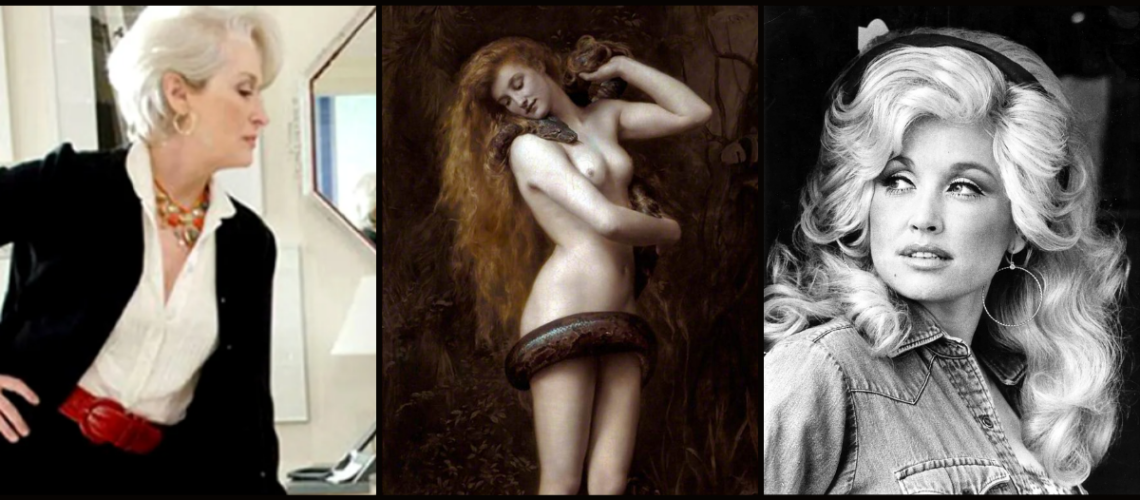
There’s actually more than one ‘Lilith’ in astrology, but let’s not get into that right now… what can I say… she’s complex!
Today I’m talking about Black Moon Lilith, a mathematical point used in astrology. This point enters Capricorn on 14th September 2026, and it represents your primal rebellion.
Black Moon Lilith represents the parts of ourselves we’ve been taught are ‘too much’... the desires we feel we should hide, reject, or be ashamed of.
And in Capricorn, we’re talking about ambition, power, money, success, and status.
The very things a capitalist society teaches us to want, yet somehow we feel a bit wrong for admitting we actually want them.
Capricorn is linked to the Devil card in Tarot, and Lilith is often portrayed as demonic. But let’s look at the myth properly.
In a later Jewish folklore tradition, Lilith was said to be Adam’s first wife, and she refused to lie beneath him or shrink herself just to keep the peace. She wanted to stay with Adam… as his equal. Demanding that made her “impossible” to keep, and she paid for it with exile. No longer diminished, but entirely alone.
“Hell hath no fury like a woman scorned”… there’s that devil energy again. But where is that energy coming from? What is really underneath all that rage? She was in pain. She was hurting!
Is that script still running today?
Capricorn is traditionally associated with authority, status, responsibility… it’s ‘Daddy’ energy.
So what happens when Lilith enters Daddy’s territory?
What happens when a woman earns more than a man? Becomes the boss? Doesn’t need to be financially provided for?
Does he feel emasculated? And does she then feel she needs to make herself smaller?
Look at Miranda Priestly in the first ‘The Devil Wears Prada’ film.
She has enormous power, ambition, and authority… a total Queen of Swords. But the first film seems to suggest what that authority costs her: her marriage.
Society used to love to peddle the idea that a woman who refuses to diminish herself ends up alone. The cold ice-queen archetype. As if isolation is simply the price of the ticket for success.
But in the second film? Not the case. This time, Miranda has a supportive, secure husband… a noticeable change.
Look at Dolly Parton. She was married to Carl Dean for almost 59 years while building one of the most extraordinary business empires in music history. By Dolly’s own account, part of the reason it worked was because Carl never tried to compete with her or control her. “He never interferes with me business-wise,” Dolly once said. “I had freedom… A big part of my whole success is the fact that I was free to work.”
Dolly didn’t shrink for the relationship, and the relationship didn’t stifle her success. She had both.
She also looked ultra-feminine. Does that make a powerful woman easier for a man to accept?
It’s one thing for a man to say he supports an ambitious woman. It’s another thing when she has more status, or becomes the more powerful person in the room.
What happens then?
Does he feel like he doesn’t have a role? And how much of this is still shaped by the old idea that a man should be the ‘provider’, the ‘successful’ one, the one with more ‘power’?
There’s a lot of talk in the dating coaching world that women need to be more in their ‘feminine’ if they want to attract a ‘masculine’ man.
With the rise of the manosphere, and renewed interest in ‘traditional’ roles, we’re seeing hyper-masculine and hyper-feminine ideals rising back to the surface.
But sometimes the feminine energy being talked about seems to mean being ‘nice’ – quiet, soft and submissive.
But what about the untamed and wild feminine?
The feminine that is powerful as fuck. There are endless examples in Mother Nature… raging oceans, wild seas, gushing waterfalls, hunting lionesses, powerful matriarchal elephants, the list goes on…
Nature isn’t always soft, gentle and accommodating. It’s often fierce, instinctive and completely wild.
Maybe the ‘feminine’ was never meant to be quite as soft and gentle as we’ve been taught.
So many women hold the belief, consciously or unconsciously, that being fully themselves and being loved are somehow in conflict. That they can have the relationship, or they can fully have themselves, but not both.
Is that actually true? Or is it a story we’ve somehow learned to believe?
The myth still resonates. We can see the archetype being played out again and again. The woman who refuses to shrink herself, refuses to submit, refuses to make herself smaller — and ends up alone.
But is exile inevitable?
I don’t think it is.
Perhaps it depends on what you believe is possible, who you’re with, and what the relationship is actually built on.
Because maybe you don’t have to choose between having the relationship and having yourself.
Maybe you can have both.
Then Lilith in Capricorn asks us:
What are you ashamed to want?
Money? Power? Recognition?
And do you know why you want those things?
When we feel repulsed by someone else’s ambition, it’s worth asking whether a hidden part of us wants those things, too.
We judge it perhaps because we’ve been taught that material success equals moral corruption… that excess here means exploitation over ‘there’. And while there is some truth in that…
Maybe we all still need to question the unconscious belief that wanting success and money makes you a ‘bad’ person… or unlovable?
Is it possible to have the empire AND a thriving relationship? AND do it all ethically?
I’d love to know… what’s your experience been? Have you ever had to shrink yourself to keep a relationship? Or found one where you could fully expand?
As always, I would love to hear your thoughts on this.
Comment below or send me a message.
With love.
Clare
Image credits: 20th Century Studios (The Devil Wears Prada) / “Lilith” (1892) by John Collier / RCA Records (Dolly Parton)
Clare Bennett is a Psychological Astrologer and founder of Temple Divine, Glasgow – a place where psychology meets soul. She offers
astrology consultations, group training and events. If any of this resonated, you can work with her or find out more at www.clarebennett.

I don’t take role playing seriously. I like strong women, but anyone (men or women) who cross the line into the world of abuse very quickly find themselves out of my life. Women who find themselves in a position of great power get respect if they have a balanced view and treat others with respect.
Thanks for reading the post and for sharing your insights. I like the way you worded this Paul. You’re right power can corrupt, or maybe it’s just that power gives people permission to show who they really are. Good to hear your thoughts on this one. Thank you.
Love this! I had heard about Lilith before but never quite understood where she fit in. I am a Capricorn and this resonates with me!
Glad the Capricorn stuff resonated with you Liann, and good to hear that it helped make a bit more sense of Lilith for you too. Everyone has a Lilith within somewhere, and it’s helpful to acknowledge that part of ourselves. Thanks for reading and commenting. Good to hear your thoughts. Clare
Leave a comment